What Is a DoS Attack? A Simple Guide to Denial of Service Attacks and Protection Methods

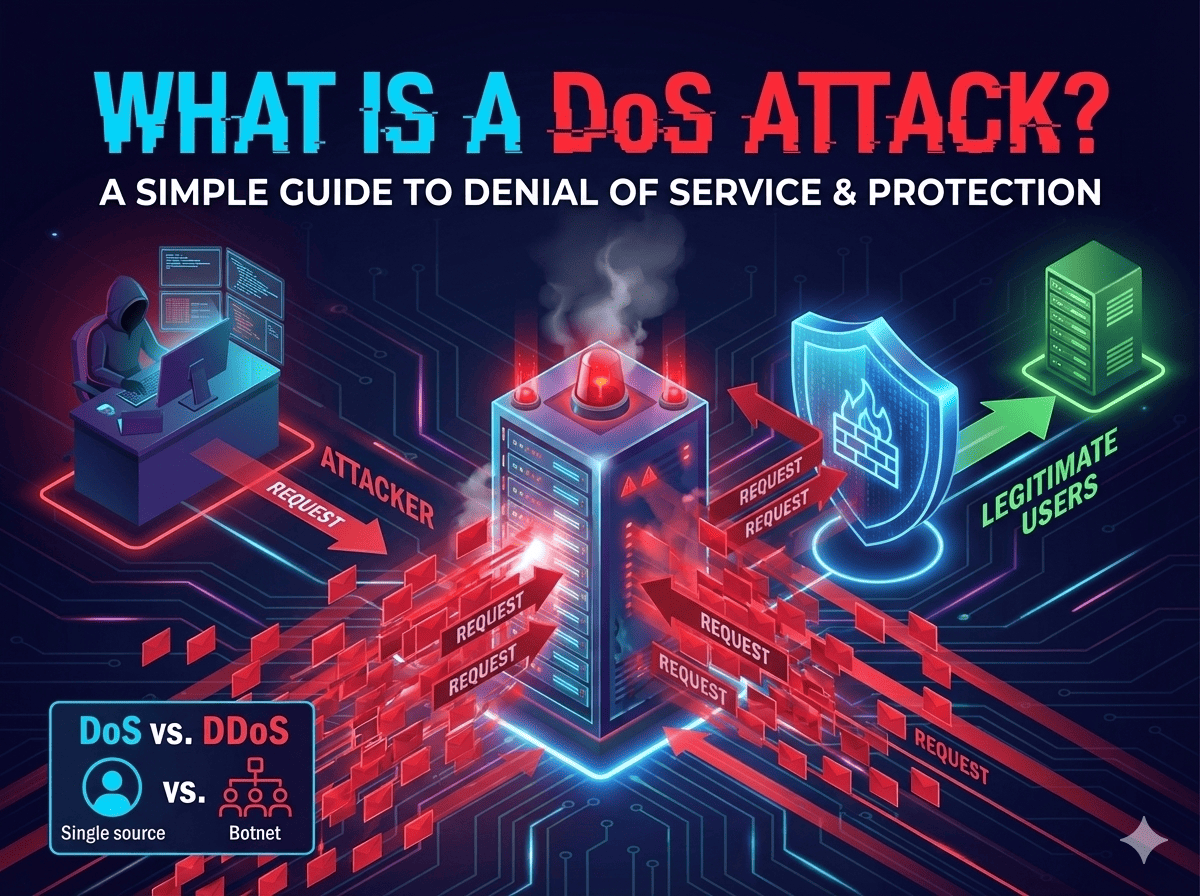
Denial of Service (DoS) attacks are among the most common and dangerous types of cyberattacks.
Instead of stealing data, their main goal is to disrupt a service and prevent legitimate users from accessing a website or server.
In this article, we’ll explain what a DoS attack is in a simple way, explore its main types, clarify the difference between DoS and DDoS, and discuss how to protect against them.
What Is a DoS Attack?
Imagine a small store where suddenly hundreds or thousands of people walk in at the same time and start asking questions nonstop.
The store owner becomes overwhelmed, and real customers are unable to get service.
This is exactly what happens in a DoS attack.
A DoS attack works by sending a massive number of requests to a server, which causes:
- Server resource exhaustion
- Extremely slow performance
- Complete service outage in some cases
Common Types of DoS Attacks
1. Flood Attack
In this attack, the attacker sends an enormous number of requests in a very short time, consuming:
- CPU resources
- Memory (RAM)
- Network bandwidth
As a result, the server can no longer respond to legitimate users.
2. TCP SYN Flood
This attack exploits how the TCP connection process works.
The attacker sends repeated connection requests (SYN packets) but never completes the handshake.
The server keeps waiting for a response, and after thousands of incomplete connections:
- The connection queue fills up
- Legitimate users are blocked
3. ICMP Flood (Ping Attack)
This attack involves sending a large number of ICMP (Ping) requests to a server, which leads to:
- Network congestion
- Slowed or completely unavailable services
Difference Between DoS and DDoS
| Aspect | DoS | DDoS |
|---|---|---|
| Attack source | Single device | Multiple devices |
| Attack strength | Limited | Very powerful |
| Mitigation difficulty | Easier | More difficult |
| Method | Direct attack | Botnet-based attack |
A DDoS (Distributed Denial of Service) attack is more dangerous because it uses thousands or even millions of compromised devices worldwide.
How to Protect Against DoS and DDoS Attacks
Essential Protection Measures:
- Use a Firewall to filter abnormal traffic
- Enable IDS / IPS systems for early detection
- Use anti-DDoS services such as Cloudflare
- Monitor network traffic continuously
- Apply Rate Limiting to control request volume
Why Are DoS Attacks Dangerous?
DoS attacks do not only target individuals. They can:
- Disrupt major websites and platforms
- Cause significant financial losses
- Damage a company’s reputation and user trust
In recent years, even large technology platforms have experienced outages due to these attacks.
Conclusion
A DoS attack does not rely on hacking systems, but on overloading them.
As digital services continue to grow, understanding DoS attacks and how to defend against them has become essential for developers, system administrators, and website owners.
Important Note:
Cybersecurity is not optional—it is a core component of any successful digital system.